Markets and shopping
LED Bulb Buying Guide: Lumens, Watts, Colour and BIS Marks
Written by Kota Market Editorial Team · Updated
LED bulbs have replaced old filament bulbs and tube lights in most Kota homes, PG rooms and shops, and the festival season adds strings of decorative lights to the list. Yet the shelves are full of boxes with confusing numbers. This LED bulb buying guide explains what the numbers on the box mean, which marks to look for, how to choose the right colour for a room and how to use Diwali lights safely.
We do not name brands or quote prices. Prices for LED bulbs vary widely with offers and pack sizes; a quality check matters more than a few rupees saved.
Lumens, not watts
With filament bulbs, people learned to ask for “a 100-watt bulb” when they wanted bright light. With LEDs, that habit misleads.
- Watts (W) tell you how much electricity the bulb uses.
- Lumens (lm) tell you how much light it gives out.
- Efficacy (lm/W) is the ratio: how much light you get per watt. Higher is better.
Two 9-watt bulbs can give quite different amounts of light. Always compare boxes by the lumen figure, and use watts to estimate running cost. If a box does not print lumens at all, choose another.
Colour temperature: warm, neutral or cool
LED light comes in different shades of white, measured in kelvin (K):
| Label | Approximate K | Feels like | Good for |
|---|---|---|---|
| Warm white | 2700-3000 K | Yellowish, like an old bulb | Bedrooms, living rooms, puja corners |
| Neutral white | around 4000 K | Clean, natural | Kitchens, dining areas, shops |
| Cool white / daylight | around 6500 K | Bluish white | Study areas, workshops, bathrooms |
Many Kota students prefer cool daylight bulbs for long study hours. That is a personal choice, but glare and poor placement cause more eye strain than colour. A well-placed table lamp, pointed at the page and shaded from the eyes, helps more than an extra-bright ceiling bulb. Our guide to student room essentials in Kota covers study-desk setup.
Colour rendering (CRI)
Some boxes print a CRI (colour rendering index) figure. It tells you how naturally colours look under the light, on a scale up to 100. A higher CRI makes food, faces and fabrics look more natural. It matters in kitchens, mirrors and shops that sell clothes, such as the sari and Kota Doria shops covered in our where to buy genuine Kota Doria guide.
The base: B22 or E27
Before you buy, check what your holder takes:
- B22 is the bayonet or pin type: push in and twist. It is the most common in Indian homes.
- E27 is the screw type, common on table lamps and some newer fittings.
Adapters exist, but they add another joint that can loosen and heat up. It is better to buy the right base.
BIS registration and the R-number
LED lamps are covered by the Bureau of Indian Standards’ Compulsory Registration Scheme (CRS), which applies to many electronic and electrical products. A registered product carries the BIS Standard Mark with a registration number that begins with R-.
How to check:
- Find the R-number on the bulb or box.
- Search it on the BIS CRS portal.
- Check that the registration is current and belongs to the manufacturer and product type shown on the box.
An unmarked bulb, or a mark you cannot trace, is a warning sign. The same check applies to chargers and power banks; see our guide to verifying an ISI mark for how ISI and CRS marks differ, and the Kota mobile market guide for accessories.
Star labels
Many LED bulbs also carry a BEE star label, which compares energy efficiency: more stars mean more light for each watt. The rules for which lighting products must carry labels have been revised in recent years, so you will see both labelled and unlabelled products. Where a label is printed, use it to compare similar bulbs. Our BEE star rating guide explains how to read the label and check it on the BEE website.
Other numbers on the box
- Rated life (hours): a laboratory estimate. Real life is shorter in hot, closed fittings.
- Voltage range: a wide range copes better with fluctuations common in some areas.
- Power factor: higher is better for the electricity network; it matters more for shops and offices than homes.
- Beam angle: wide for general room light, narrow for spotlights.
- Warranty: many LED bulbs come with a replacement warranty. Keep the bill and box.
Why LED bulbs fail early
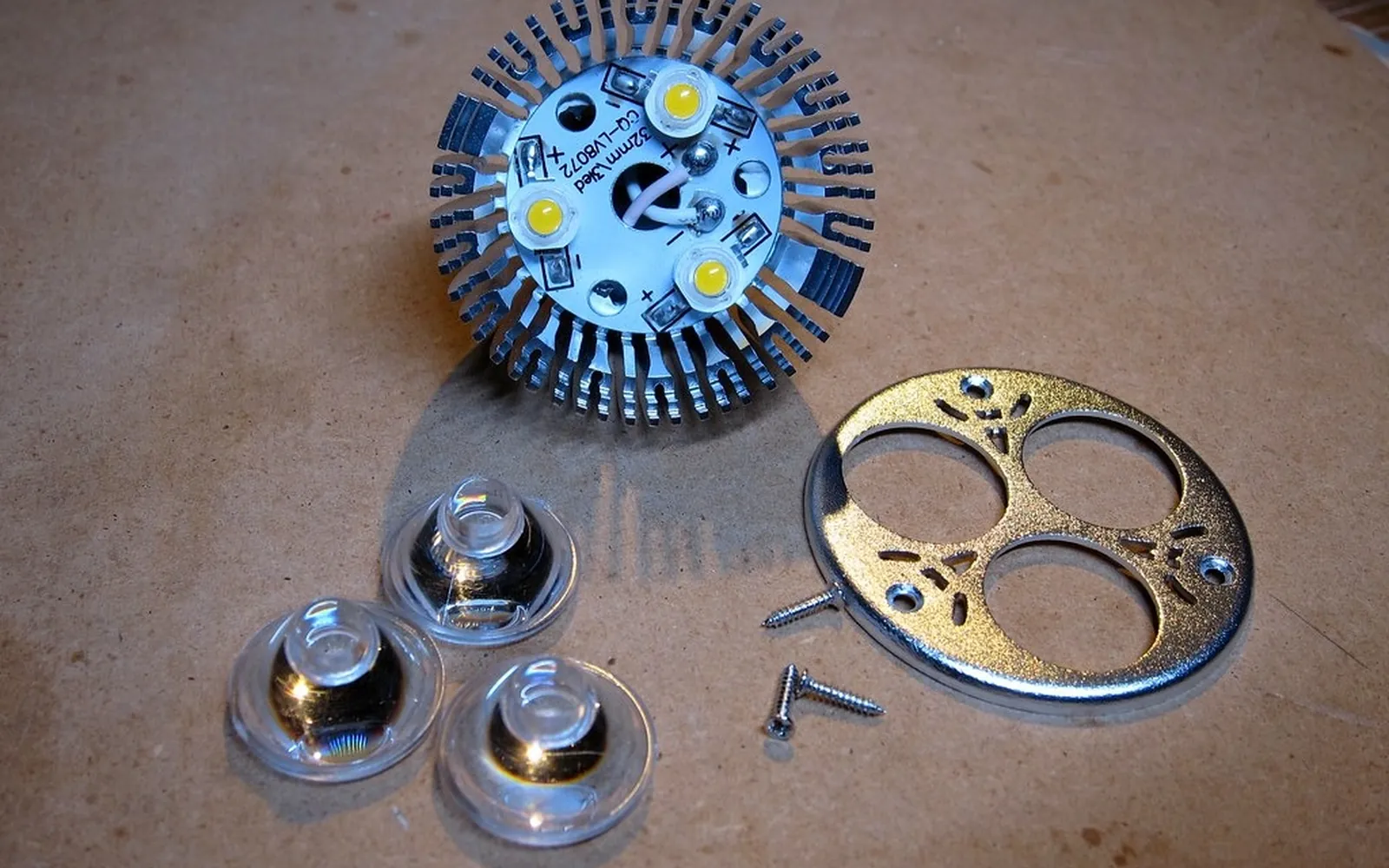
The LED chips themselves are long-lasting, as the photo of a lamp taken apart shows: the chips sit on a board fixed to a metal heat sink. What usually fails is the driver, the small circuit that converts mains power for the LEDs, and it fails faster when it runs hot.
- Avoid fully closed fittings for ordinary bulbs unless the box says the bulb is suitable.
- Do not use a normal LED on a dimmer switch unless it is marked dimmable.
- In areas with frequent voltage swings, a bulb with a wide voltage range lasts better.
- Loose or burnt holders cause flicker; replace them. For wiring problems, our guide to hiring an electrician in Kota helps.
Diwali and decorative lights
Strings of LED lights are cheap and cheerful, and they are everywhere in the weeks before Diwali. They are also behind many small electrical accidents.
- Avoid unmarked strings with very thin wire, loose joints or no maker’s name.
- Do not chain many strings into one plug, and never plug several adaptors into each other.
- Keep lights away from curtains, paper lanterns and water, and do not run wires under rugs or through door hinges.
- Outdoor use needs lights and connections suitable for outdoor conditions.
- Switch off when you go out or go to sleep.
Our Diwali shopping guide for Kota covers the rest of the festival list, and the inverter battery buying guide explains how efficient lighting reduces the backup you need during power cuts.
Lighting a shop or a PG
Shopkeepers and PG owners often buy bulbs and battens in bulk. A few extra points apply:
- Buy one sample first and live with it for a week before ordering many.
- Keep one colour temperature throughout a room or shop floor; mixed whites look untidy.
- For display counters, higher CRI makes fabrics, sweets and jewellery look natural.
- Keep the bills together so warranty claims are easy.
Old bulbs and tubes
LED bulbs contain electronics and should not be thrown in with household waste. Old CFLs and fluorescent tubes contain a small amount of mercury; do not break them indoors. Our guide on how to dispose of e-waste explains where these should go.
If a bulb fails under warranty
Take the bulb, the box and the bill back to the shop. If the shop refuses a valid warranty, the steps in our warranty vs guarantee guide and the National Consumer Helpline apply.
Frequently asked questions
How many lumens do I need for a room?
It depends on the room's size, wall colour and use. A small bedroom needs far less than a study table or kitchen counter. Compare the lumen figure on the box with the bulb you are replacing, and use a separate task lamp for reading rather than one very bright ceiling bulb.
Which is better for study, warm white or cool white?
Many people find cool or neutral white (around 4000-6500 K) helps them stay alert for study, while warm white suits bedrooms and living rooms in the evening. What matters most for study is enough light on the page without glare, so a good table lamp often helps more than a brighter ceiling bulb.
What is the R-number on an LED bulb?
It is the BIS registration number under the Compulsory Registration Scheme, printed with the Standard Mark as R-followed by digits. You can search it on the BIS registration portal to see the registered manufacturer and product.
Why do cheap LED bulbs fail quickly?
The LED chips themselves last long, but cheap bulbs often use weak drivers and small heat sinks. Heat and voltage swings damage the driver, which then fails or flickers. Bulbs in closed fittings or hot kitchens fail faster.
Are LED serial lights safe for Diwali?
They can be, if they are properly made, marked and used carefully. Avoid strings with thin, loose wiring or no markings, keep them away from curtains and water, do not join many strings into one socket and switch them off when no one is home.
Sources
Editorial team
The Kota Market team writes and updates the shopping guides on this site and corrects them when readers point out errors.